
Case Study
RGP Connect
Feature add to connect the climbing community.
Sender One x RGP Connect
Sender One is a premium indoor rock climbing gym with locations across Souther California. The feature a variety of bouldering, top-rope and lead climbing. Several times a week new routes are established throughout the gym.
RGP is a third-party app available for SenderOne members to access a digital scan tag, register for classes, and see gym information.


A common problem
A Crushing Day
At the Gym
You’ve been trying and failing for weeks.
Today is the day you’re going to finally finish
the climb you’ve been projecting.
But wait... No, It can’t be... A nightmare scenario.
The route is no longer there.
If only you had known.

Little Transparency Between Members and Setters
The routesetters have an internal schedule of when they will be establishing new climbs in the gym yet the members are kept out of the loop.
While a bulletin board (left) is available, it shows limited information and is seldom used. Of members interviewed, 80% of had never utilize the bulletin board.
The Assignment
What New Feature Would Resolve Climber's Issues?
As a member of the climbing gym, I’ve heard multiple members go through this routesetting frustrations, yet little has changed. I conducted formal interviews to investigate these anecdotal issues and develop a solution utilizing the existing RGP platform.
My Role
Product Designer
Scope
Research, Strategy, Wireframes, Prototype, Testing
Timeline
12 weeks
Tools
Figma

Final Routesetting Wireframes
The Solution Evolved Throughout Due to User Needs
Anecdotal research implied that a big user issue was access to routesetting information. In depth interviews showed otherwise, however a feature solving routsetting struggles was still within scope.
Five Participants in Initial Interviews
Variety of Climbers,
Similar Responses
1-6 Years Experience
New climbers were interviewed to see if this feature would help them as well.
Indoor and Outdoor
Experienced climbers use indoor climbing as preparation for outdoor climbing.
20-30 Years Old
Users under 40 were the primary target as this is a mobile forward app.
1-30 Times per Month
Some participants climbed as often as daily, others climbed more casually.
Five Participants in Initial Interviews
Barries and Motivators to Climb Foreshadowed Users Biggest Issue
The affinity map revealed that one of the biggest issues climbers faced was scheduling with their climbing partners, followed by regression from inconsistent climbing. What participants enjoyed was the physical and psychological challenge, and the climbing community.


Five Participants in Initial Interviews
Barries and Motivators to Climb Foreshadowed Users Biggest Issue
100%
Preferred climbing with friends or groups rather than solo
80%
Gym closure for route-setting would not impact their decision to climb
0%
No participants reported the routesetting schedule as being very important
60%
Have never looked at the available routesetting information
Competitors
There climbing app market is relatively small with Kaya and Mt. Project largely dominating the space. However neither off strong partner finding features.



Charting Feature Impact Highlighted Clear Direction
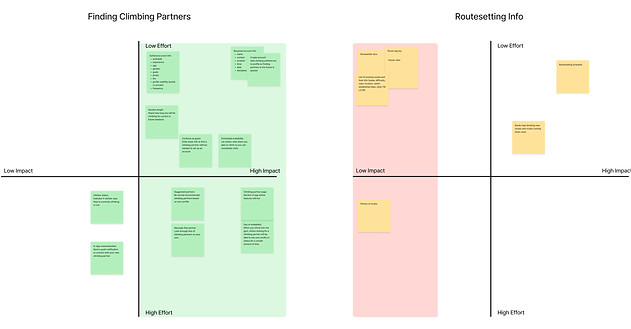
Help find a climbing partner is more impactful from users and business perspective
Reprioritizing New Feature Set
Finding Climbing Partners
The feature interview participants were most interested in. Sender One has other avenues to connect climbers, but they are not effective.
Routesetting Schedule
Easy access to routesetting information is still of interest, but not the highest priority. RGP would be a good tool to solve this issue.
Updating Account Info
Needing to update your account in person is a frustration of users. However not one that could effectively be solved in RGP.
In-App Connection, Native Communication
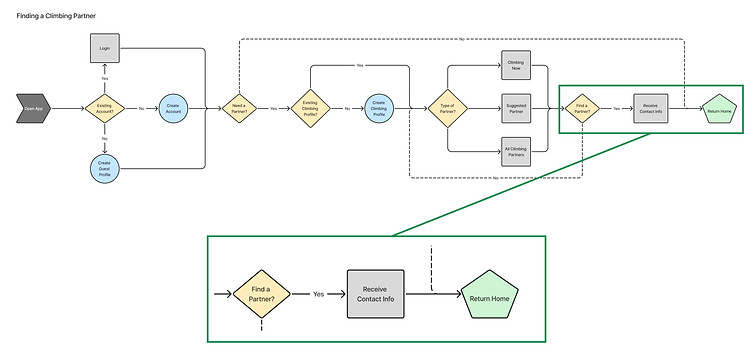
Climbers interviewed all preferred to text or call their climbing partners, rather than message them inside the RGP app.
Creating Something New Within Existing Constraints
RGP has an extremely simple UI framework. While this made the designs simple, which made designing an effective and on-brand feature challenging. Multiple iterations and tests were required.

Balancing Business’ Engagement Goal with Users’ Efficiency Goal
Mid-fidelity testing showed that users wanted the quickest way to find a climbing partner. Building a profile would not only increase engagement, but allow RGP to find better matches among available partners.
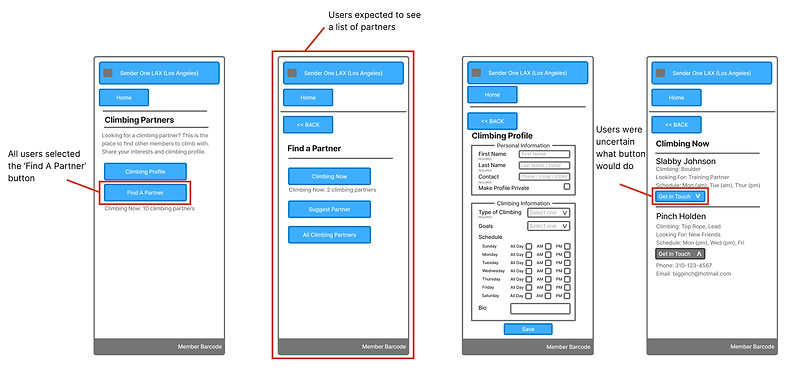
Mid-Fidelity Testing Revealed
Button Options Weren't Serving Users
Multiple menus and buttons needs to be re-designed to encourage profile creation and meet users expectations.
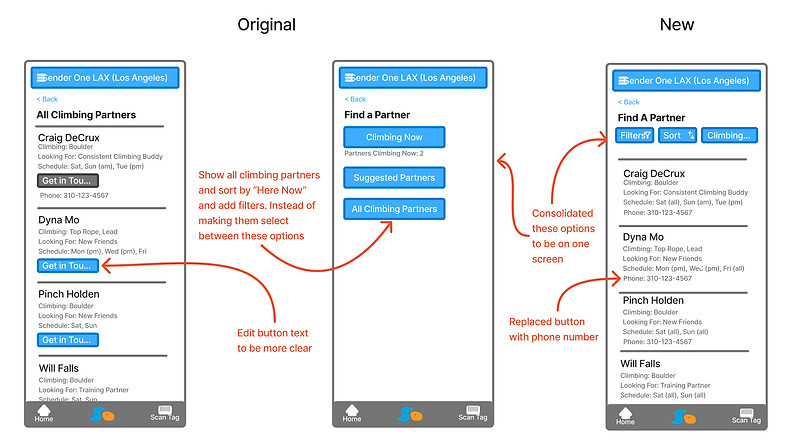
Revisions
Consolidated Screens to Quicken Task Flow
Converting the “Find A Partner” page into a set of filters drastically smoothed the user’s experience and actually increased functionality.
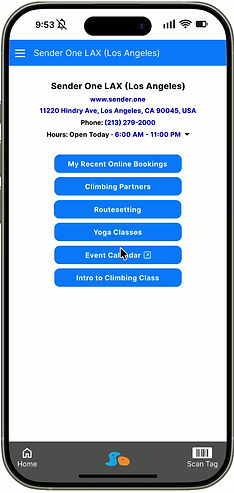
Hi-Fi Figma Prototype
The same participants from the user interviews and usability tests were used for final testing. Creating a comprehensive prototype helped unveil detailed insights, but also posed many challenges.
Prototype Link: https://bit.ly/rgp-prototype
Usability Test Key Metics
83% Said Design was Very Effective
Based on open ended responses in addition to test results
67% Created Climbing Profile
Increased from 0% during low-fi testing
100% Clicked On Profile, Not Contact Info
No users clicked on the intended CTA text immediately
Revisions based on usability test
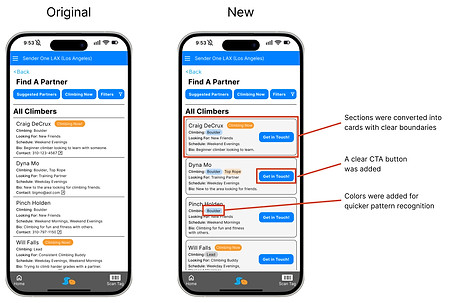
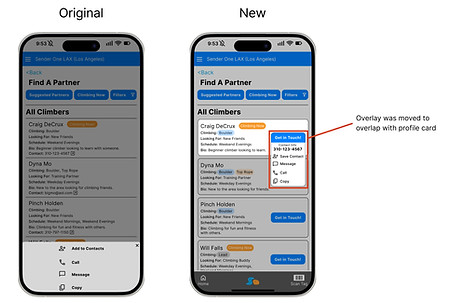
Clearer CTA and Improved Grouping
Larger buttons with defined card boundaries and more intuitive grouping to make interactions natural
Take Aways
Approaching user interviews with genuine curiosity lead to the discover that while routesetting was an issue, it was not the biggest issue members faced. Connecting with the community and climbing together became the focus and lead to a bigger impact on user. Four of six users said this new feature would be very helpful to them.